Showing posts with label Scotland. Show all posts

Tuesday, 18 November 2014

Research Visits: Are They Important?

I am in the middle of writing my first historical fiction book, the working title of which is: The Touching of Stones. 

Initially I saw it as a trilogy, though it may possibly turn into a saga, as I have an ongoing idea of where my story will go. and for this reason I feel it is important for me to visit the places that I am writing about. I also think that even if it wasn't my first foray into historical fiction, I would still need to visit the places that I will be writing about. 

I visited Edinburgh in May to research St. Giles' Cathedral, Rosslyn Chapel, and John Knox House. I felt it was important to visit these places to obtain some idea of their history first hand, and to soak up the atmosphere too. In all of these places the history was, and is, palpable, and I wasn't disappointed either. The visit added much to my Work in Progress. Without the visit I don't think that I could have placed my characters securely within the story.

This begs the question: How important is it to visit the places that will be in your story?

I have read, on Facebook, that some authors include places in their novels that they have not visited. All their information having been gleaned from books, or the internet and still create the atmosphere that is needed. I am lucky inasmuch as I am able to visit Scotland, but if my novel had been set in Australia, or New Zealand, then I would be able to go, but find it a little difficult, I think. It would be better to rely on information gathered from books and DVDs, and the like, not to mention much cheaper!

Having said all that, taking a research trip gives the mind the opportunity to concentrate more fully on the writing process, I think. When I was in Edinburgh in May I wrote more freely, not being hindered by the normal run of the day. Plus being in the place in which you are writing helps enormously. Well, it certainly helped me, and I know that we are all different.

So, I went back again on 7th November. This time I stayed for a week. Four days in Stirling and three days in Edinburgh. It was a real boon. When I was in Stirling, I visited the castle, The Wallace Monument, Stirling Bridge, and The Robert the Bruce statue and visitor centre. The visitor centre was very helpful. They have a weapons handling room. This is where I really appreciated the weight of the mail, the coif, the helmet, the sword, all of it. It gave me a real sense of the power that the knights had, the stamina, and the weakness if pulled from their horse. Once on the ground, they were practically helpless because of the shear weight of that which they wore.

In Edinburgh I was lucky enough to come across some stone masons at St. Giles' Cathedral. They were engraving the name of the cathedral in the stone: St. Giles' Cathedral. There will always be controversy over whether St. Giles' is a Kirk or a Cathedral to the people of Scotland, In St. Giles' Parish Profile they refer to it as: St. Giles' Cathedral, The High Kirk of Edinburgh. The controversy continues. 

The stone masons had taken two years going through different procedures with the authorities in order to be able to engrave St. Giles' Cathedral into the stone in front of the main entrance. 

They had started the previous day sketching out the letters, measuring them, to get them equidistant to each other. On the day that I first came across them at around 13.30, they had been at work since 08.00 that day, and had already achieved the full work, but were doing finishing touches ready for the next day. This is when they painted the lettering a beautiful dark red, made from natural minerals mixed with a spirit. The idea was for the lettering to stand out from afar. At first I thought it a shame to paint them at all, but on reflection, I think I have to agree that it does look so much more stylish; it has a certain permanence.


As my WIP is fundamentally about a family of stone masons whose lives get caught up in the politics of the Scottish War of Independence, among other events through time, then I felt it most fortuitous to come across these wonderful people in the execution of their work. I visited them on two consecutive days to view how the work was coming along. As you can see by my pictures, for which I have their permission to show, their work is splendid in every detail. The weather was bitterly cold, a face-numbing cold, and they sat there cheerfully carrying out their work. Although I have had a continuing interest in stone masonry for some years, I learned a lot from them, which will be a great help in my writing.

My visit to Stirling Castle, The Wallace Monument, and The Robert the Bruce Centre was extremely helpful, and I am really glad that I went to all three places. The castle was extraordinary, and I spent most of the day there. It was captivating, the architecture, the furniture, the tapestries.... marvellous. I had an audio-guide, so that I could just take my time in each part of the castle, and listen at my leisure, depending on where I was in the castle. I took many photos, thankfully these were not prohibited, as in The Writers' Museum, which I visited whilst in Edinburgh.

One of the guides


Beautifully crafted furniture

Replica wall tapestries
each one taking longer than two years to complete

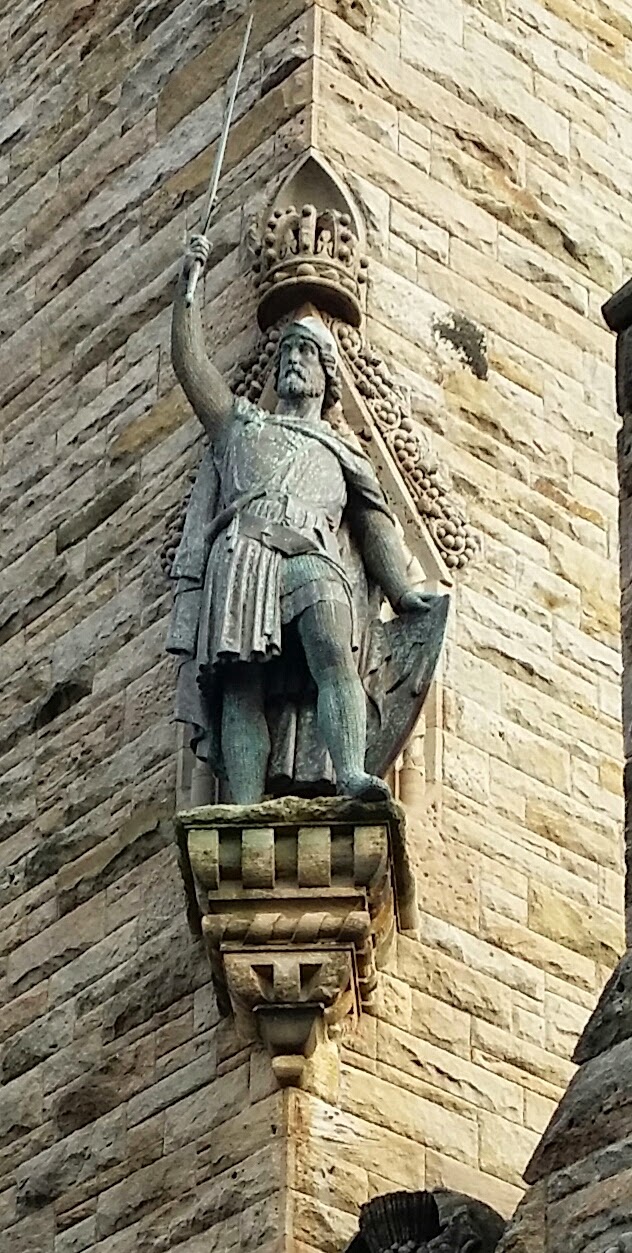
View of The Wallace Monument from Stirling Castle
A detail from The Wallace Monument - William Wallace
Robert the Bruce at the
Bannockburn Heritage Centre
I knew it was large, but it is enormous!
For myself, and I can only talk of my own experiences, the visit to the Bannockburn Heritage Centre was one of the most important visits I made. An afternoon well spent.

Edinburgh Castle, missed the first time in May, was a totally different experience, being a working castle. I stayed there for about three hours, and tried to imagine how it was back in the day. Not much different to how it is now, I imagine. The history, as with Stirling Castle, is palpable. I sat on a bench, shut my eyes, and just listened. When I had managed to edit out all the nations that were wondering around, I imagined how it would have been. It is a formidable place, I also experienced the two minute silence for Armistice Day here. It started with a gun salute, and finished with a gun salute. The intervening two minutes silence was extraordinary.... there was a crow hopping around my feet pecking at crumbs, another came and squabbled for them, a fluttering of wings, cawing, and then silence. The second gun discharged, and the birds rose momentarily, and settled back to scavenging, and the hubbub of the people restarted, rising incrementally as each group resumed their tour.

Two hours later it was the One o'clock Gun. This time I was no more than 20 feet away, and when it went off, well, you can imagine, it was deafening. Difficult to know which was the louder though, the gun or the teenage girls screaming and laughing straight afterwards.

So, to answer my question at the top of this blog; How important is it to visit the places that will be in your story? I would have to answer yes, it's very important to visit those places, if it is at all possible.

All in all, my visit to Scotland was a complete success, what it has left me with, however, is writers' block. I have so much information which I am trying to put into some order, that my writerly mind has quite simply checked out, and my 'organising the information' mind has taken over. Very frustrating!

I've had many suggestions from fellow writers on Facebook, after I had asked how others cope with writers' block, and I am on my way to trying them one by one. I have no doubt that once the muse has recovered from her holiday, I will be off to the thirteenth and fourteenth centuries again, and, yes, I will most definitely be sometime, the muse willing!

You can find me on these links:

My book Future Confronted, which has been awarded a BRAG Medallion, can be bought in paperback from CreateSpace and as a Kindle from amazon

Tuesday, 27 May 2014

My Research Trip to Edinburgh


MY RESEARCH TRIP TO EDINBURGH

On the 5th May I started on my journey to go to Edinburgh to research my first historical fiction novel, The Touching of Stones. I have already done quite a lot of research on the internet, and through books, but quite honestly there is nothing quite like researching in the place that you are writing about.

I needed to get a feel for the place, the atmosphere, hear the accent, in short, just drink it in. At first it was all overwhelming. For one thing, the main accent that I kept hearing on my first day out and about, was American, then it was Chinese. Finally I tuned into some Scottish accents. Well, that took me by surprise. At first I found it hard to latch onto. Then, slowly, I unravelled the sounds. It is a soft accent, like listening to music. The rhythm of the speech is delightful. Now all I need to be able to do is to write in the accent. Some authors that I have read manage this very well, and I hope that I will be able to do the same.

I had planned for my book to be the first of a trilogy, though, since having visited Edinburgh, there may well be more than three. The Rosslyn Chapel, and St. Giles' Cathedral will be featuring to a large extent in book one of The Touching of Stones. I was, therefore, enthralled when I finally visited these places of worship.

I visited St. Giles' Cathedral first as it was literally just around the corner from my hotel. I was so excited that I could hardly contain myself. I donated my £3 entry fee, then paid my £2 for the permission to take photographs, and then ventured, slowly, to my first point of interest; the Robert Louis Stevenson Memorial.
Robert Louis Stevenson Memorial
This is a large bronze casting made in 1904 by Augustus St. Gaudens, the renowned sculptor from America, and a great admirer of Robert Louis Stevenson. It really is an imposing memorial. I took my photo, the first of many, with my mobile phone. I then walked, awe struck, along the wall looking up, and back, and over.... trying to take it all in. I stood stock still and just listened. It was 09:45, and there was the hubbub of the public whispering, rising and falling, and then there was silence. The silence grew, surrounded me, and brought a peace that then followed me all around the Cathedral no matter who else was there. It was like being in my own bubble. My thoughts were tumbling as I viewed each piece of wonderful stone work, statuary, wood carving, stained glass window. I have been in many Cathedrals, admiring them for their architecture, their beauty and their sanctity. St. Giles' has a special aura about it. One that I haven't experienced in any of the others. It may be the multiple side chapels, each with their own quietude, a special ambiance of serenity.
The Memorial of James Graham, 1st Marquis of Montrose


  I felt almost as though I were intruding as I leaned forward to read the inscriptions. I whispered an apology as I took a photo. I stepped back to gaze up at the highest point and just wonder how they ever achieved such craftsmanship.

I wondered further along and came across another side chapel. A £2 charge for entering this one. My goodness! I had just entered The Thistle Chapel. The wood carving in this chapel was astounding in its detail.
An otter devouring a fish
Intricate filigree work all about, and on the pews were carefully carved animals. It felt as though, once we were all gone, the animals would scamper about so real were they. As you can see by the photo on the left, the detail in the carving is quite astonishing. Up close and personal, the otter has an angry face, almost challenging anyone to take his/her fish away. There were many such carvings in this side chapel, all of equally splendid workmanship. 
Detail from the pews


Study the detail in this one to the left. The intricacies of the flowers and the berries. I stood for many minutes studying this particular carving. I was trying to imagine the artisan working with his chisels, meticulously paring away the wood to reveal the objects within. I have always been in awe of both wood and stone carving. In awe of how the artist sees inside and then releases a three dimensional object so that we can see what was in his imagination.


I gradually made my way around the cathedral. To be truthful my neck ached from looking up at the wonderful roof. All cathedral roofs are a mathematical wonder to me. They are both beautiful and inspiring. Just look at all the detail in the picture below. The picture doesn't do it justice, but it is breathtaking. It really does look like the roof is stretching up towards heaven. 


Detail of the ceiling
In my young days I spent every Sunday in church and Sunday school. I would gaze up into the highest parts of the ceiling of our church and begin to wonder how on earth was it possible for all that to stay up there. Those highest stretches reaching across from pillar to pillar. It was as though they were outstretched arms pushing the ceiling upwards, stopping it from falling on us, the congregation. It was then that my initial fascination with both church and cathedral architecture hooked me, and eventually, in my retirement years I was drawn to the idea of writing a book featuring stone masons. I have gleaned quite a bit of knowledge over the years, but since deciding to write my book I have studied the architecture much more closely. As many would have seen on Facebook, I have bought several books on stone masonry and cathedral building. Some of my Facebook friends jokingly asked if I had planning permission to build a cathedral in my garden... Why of course I have!


Detail from the pulpit
Here are some of the exquisite details from the pulpit in St Giles' Cathedral. As you can see, the detail of the work is truly intricate. This work leaves me in wonder. The skill, the concentration, the determination to transfer a picture from the mind into a three dimensional object, it just truly astounds me.

Not all of St. Giles' Cathedral is from the 1400s, in fact there is very little of it left from that time now, but I find that it gives a real sense of how a building can still be relevant even though it has gone through many additions and alterations though the centuries.


John Knox
I finish with John Knox, (c1513-1514 - 1572), of which there is a really formidable statue. His statue is a rich black, and quite startling at first sight. It was cast by Pittendrigh MacGillivray in 1904, and is placed near the west end of the Cathedral. I have to admit that I just stood staring at the statue for quite some time. I was trying to remember my history about this man. The statue is life-like, although I would think a little larger than life-size, and if you stand really close to it, it is as though the man that was John Knox knows you are looking at him. It almost feels an intrusion. I did, however, study him quite closely. I wish that I could have asked him the questions that were buzzing around in my head. Would I have liked the answers? Probably not, but I'm sure we would have had a really interesting discussion. When standing directly in front of the statue and staring directly into his face, I saw a man full of religious fervour, his face has a great intensity about it. He is indicating to his Bible, as if reinforcing a point that he is making. His left foot looked in readiness to walk toward me, and I took a step back. I looked at him, his hat, his beard, his clothes, his shoes...I nodded to myself, thinking, this man was not going to go unheard. Nobody was going to ignore him or his sermons, and that was very evident from the stance of the statue. Yet again I was in awe of the sculptor, the person who could bring an historical figure to life so that we could all experience 'the man' that was John Knox.

The next day I visited Rosslyn Chapel. I had wanted to for so long, but never imagined that I would ever visit Scotland, let alone Edinburgh. I asked the receptionist at my hotel to call me a taxi, and sat down in the foyer to wait for it. While I was waiting I looked at my WIP notes that I had in my jotter. I had underlined the parts of the Chapel that I wanted/needed to look at that were important to my story. Like St. Giles' Cathedral, it too had undergone many changes since the 15th century.

The Chapel taken from the Visitor Centre
When the taxi picked me up, it was like having my own guide to Edinburgh. What a mine of information he was. He pointed out places of interest, and I was getting neck ache twisting this way and that way. Then we parked at the Rosslyn Chapel. Oh my goodness! I'd seen it on TV the week before I went to Edinburgh so I knew all the scaffolding was down, and so wasn't surprised by that being gone. What I was surprised about was the fact that it had a most modern Visitor Centre an immense juxtaposition to the Chapel. Gifts, trinkets, café with a wonderful view over the hills, and everything homemade. Homemade scones, soup, bread, and the aromas were very enticing. 

Anyway, I bought my ticket and guide book and was told that a talk would take place in the Chapel in about 10 minutes. So off I went. As I walked through the door into the Chapel all I could hear was the rumbling murmur of the visitors awaiting for the talk to start. It was packed. I found myself a seat at the back on the centre aisle end. I busied myself looking up at the ornate carvings on the ceiling, and down the walls. The many carvings of the Green Man, the flowers, the birds, everywhere I looked there was an image full of meaning. The stonework on the outside of the Chapel is in stark contrast to that of the inside. We were not allowed to take photos of the inside, but I can assure you the difference would need to be seen to be believed. Just imagine most of it had been open to the elements for years, and despite there being evidence of algae still, the restoration is extraordinary.

A detail from the rear of the Chapel
The work involved in the restoration must have been arduous and the results are incredible, and quite simply stunning. The Apprentice Pillar, for example, famous for its beauty, is so different from its many pictures. Up close it is more detailed, more intricate, more 'holy' than can be put into words. The picture to the right of this page is a detail from the rear of the outside of the Chapel. It is one of several alcoves with stone seating. I would imagine that they were necessary to sit out of the wind. The Chapel is built on an extremely windy hill. When I stepped into the alcove, it was almost still and silent, then just step back away from it and the noise of the wind takes over. So I stood in the alcove for a moment and tried to imagine what it must have been like back in the day. It started to rain, so reluctantly I moved to go inside the Visitor Centre again.

I went to the café to have some much needed lunch and a warm-up. As I waited, I got my notebook out again, scribbled some notes of what I had seen, and what the guide had said in her talk, which had taken about 35 minutes. All very interesting. My soup and roll arrived. Too hot to eat, so I sipped my tea and flicked through my guide book. The sky darkened, heavy clouds, pouring rain, gusting wind. The café filled up with customers looking for somewhere to sit and wait it out. It became so noisy that I just put my notebook away and finished my soup.

I had been given a card by the taxi driver to call them when I needed to go back to town. I did this, and only waited ten minutes. As I sat in the taxi, drifting away in my thoughts about what I had seen, my WIP started fitting together. I was becoming excited now. Having seen this most beautiful of places with my own eyes I began to have a sense of my characters, their foibles, their lives, their speech. Up until this point, most of the accents that I had heard in Edinburgh had been foreign, but at The Chapel, I heard Scots. Familiar words taking on new sounds, faces so animated, so friendly, so caring. I was falling in love with Scotland. My maternal grandmother was born in Stirling over 120 years ago. My mother visited Scotland many times in her childhood, but we, as a family, never went there. I was but a 16 month old baby when my grandmother died. I don't remember her voice at all, but my mother always told me that it was a soft accent. This I can now understand. I never quite knew what she meant by a 'soft accent' but it is a most fitting description.

This time my driver was the silent type, so I had plenty of time to think about my day. I may possibly have to go again. Take more detailed pictures of the outside. All in all, though, it was very productive. I had such a wonderful visit, especially the inside of the Chapel. Only when you have seen it with your own eyes, can you truly appreciate its splendour, its ambiance, its holiness, after all it is a living working Chapel, used every week for services. Quite simply outstanding, outstanding.

I have been back home now for just over two weeks. My notes now have annotations around them. I've started to read the books about stone masonry that I bought once I got back home. They are so interesting, absorbing even. Writing my historical novel is going to be really enjoyable, even down to the mundane aspects of a life. 

My main character is Nychol Granger. At first I thought him to be the youngest child of a master stone mason. But he told me otherwise. He told me he was, indeed, the eldest child, and because of that he felt that the story should lead with him. I listened to him, I did, but I'm not sure yet where I want him to come into the story. He's angry with me. He wants to be on the first page. I will have to do an edit or two, but I'm sure he will be pleased where he comes into the story, I know I am. And, well, Nychol will just have to grin and bear it, won't he? Or will he get me to change my mind?

Louise can be found on Facebook here

Her book Future Confronted can be purchased here


Monday, 24 March 2014

My Writing Process - Blog Tour

MY WRITING PROCESS - BLOG TOUR

Simon A. Stirling has tagged me in the Blog Hop talking about our writing process. I only know Simon through Facebook, and enjoy his posts very much. I am also a great admirer of his books, 'Who Killed William Shakespeare' and 'The King Arthur Conspiracy' - very interesting books indeed. Simon posted about his writing process on his own blog last week, and you can read it here.

So, now it is my turn to answer the questions that we have all been invited to answer as part of this fascinating blog tour.

1. What am I working on?

At the moment I am doing research for my next book together with the story-line and character development. I love to make lists, so this is how I start with my research. One list for names, one for architects of the time that I will be writing in, and a list for the 'everydayness' of that period. For example, how people would be living. What were their homes like? How were they furnished? What would they be eating? How would they cook it? What were their clothes made from?

My WIP which has the working title The Touching of Stones, is about a family in the 15th Century whose men folk are stonemasons carried on from generation to generation. My novel will be featuring The Rosslyn Chapel in Roslin glen, Scotland, St. Giles' Kirk, in Edinburgh, Scotland, Chichester Cathedral in Chichester, West Sussex, England, Canterbury Cathedral, Kent, England, and the Basilica Santa Maria del Fiori in Florence, Italy. Beautiful buildings, each one unique, with stone work so magnificently tooled, and stained glass windows which demonstrate the ultimate art of storytelling.

2. How does my work differ from others of its genre?

My first book Future Confronted was a biography, so this will be my first venture into writing historical fiction, so I am going to endeavour to be original. It is a story that I have had roaming around in my head for some time, and the main premise, as I said earlier, is about a family whose men folk are stonemasons working on churches and cathedrals. I love the history of stone-masonry, and the people whose ideas have come to life that we now see in the cathedrals around us, one of the most extraordinary examples of the intricacies of their art being in Scotland, and it is The Rosslyn Chapel.
The Apprentices Pillar, Rosslyn Chapel
So from that point of view, I think my novel will travel a different road from others. I envision it being at least a three book series, maybe more, running from the 15th century through to the 17th century, following the generations of one particular family.

3. Why do I write what I do?

The love of history, the love of history, and the love of history, it's as simple as that. I have always been fascinated by history, and the people of different times. I have my favourite periods, which are wide ranging, going from the ancient Roman period through to 12th and 13th century  England, and 12th to 15th century Mongolia, having studied Genghis Khan and his descendants. I also love the period that I am writing about at the moment. I love the architecture of this time, as always, architecture is an exemplar of the era, a bookmark if you like, of how the world was during that time.

Churches and cathedrals have their own special styles, their own special...fingerprints if you will. There is so much to consider when building a church or cathedral. Apart from the time it takes to build, some taking longer than 100 years! There is the hewing of the stone from the quarries, the transporting of that stone, the gathering of people, the craftsmen for the different aspects, the stained glass windows, the dressing of the stones, the flooring, and the arches. It leaves much for the author to play with. All the lives involved, all the different paths the story could take. It's almost a carte blanche situation, as long as the history isn't tampered with.

4. How does my writing process work?

Well, I get an idea, I write it down in my 'Ideas Book' which I keep by my bed. I am very often awake for a few hours in the night, so I am either reading or writing down ideas. I then transfer the idea to my WIP book. Here I do spider-grams of all my ideas. For example, I would have my main idea in the centre circle ( and I am not talking Google+ here!), and from that I draw spider's legs with more circles. These circles will have the 'cast of characters'. From there I would take each character and have him/her in the centre circle with the spider's legs radiating out each with their own circle, and so on. When I am happy with that, I give each character a life. This is something that I learned to do at university when I was studying creative writing. We were taught that if you give your characters a three-dimensional life before you write about them it makes them feel like real people. So I give them traits, for example how they would speak, what they like and dislike, give them their little idiosyncrasies, you get the idea. I'm sure this is common practice for many writers.

I like to have pictures of the places that my story will visit. I have them pasted in my Ideas Book, together with maps of the towns that my story will visit. Going to the places that I am writing about also helps. It helps with the research, as does taking many photos. It gives more of an atmosphere to the writing process. The visits evoke the senses, and the imagination.

I like to write straight on to the laptop, and just keep going. I try not to take notice of mistakes as my priority is to get the basic idea down without double checking myself, there will be plenty of time for the editing process later. Sometimes I am totally surprised where my story is taking me. Who knew? So then I have to carry on writing, just to see what happens! I like to make sure the history part is correct, I can't change history, but I can change my story to fit.

For me, the research is most enjoyable. I love it, just love it. Sometimes I go off on a tangent just through the reading, and wonder if I can perhaps fit that piece of history in as well...So, that is me. That is my writing process.

Following me on The Writing Process Blog Hop Tour is Rob Bayliss whose blog can be found here. I know Rob from the Facebook group The Review Blog page where I am on the Admin team, and where we both review books. Please meet Rob Bayliss!

My name is Rob Bayliss. In all honesty I've always been a bit of a history geek, and a sci-fi and fantasy nerd. I've recently discovered the joys of writing and I'm currently working on a clockpunk fantasy series. I also review books for the Review Blog, which is a great way of expanding my reading experience.


Saturday, 1 March 2014

Researching My Next Book

THE NEXT STEP

Well, it's almost three months now since my book Future Confronted was published. It has been some what of a journey I have to say. The learning experience is something I wouldn't have missed, it has been a real eye opener, what with the proof-reading, and the copy-editing. I have had some lovely 5 star reviews on amazon.co.uk which have touched my heart, and I thank all those who took the time to write one. I am hoping to get my book into libraries, and because I have had some great feedback on the book, I think it will serve me well, and I look forward to seeing it on the non-fiction shelves.

WHAT AM I UP TO NOW?

More than two years before I finished Future Confronted, I had started researching a story which I longed to write, one mainly set in Italy during the 15th century, but included a long journey. I love this era in Italian history, it's so varied, so interesting not only politically, but with the church and with art. I had a germ of an idea grow while I was daydreaming looking from my bedroom window out across the sea. The boats in the marina were bobbing up and down, swaying from side to side in the wind, their ropes clanking on the masts. Before I knew it, I had an outline in my head which tucked itself away for a rainy day. The idea surfaced, and I tinkered with it, and tucked it away again while I got on with Rob's story.

WORKING TITLE: THE TOUCHING OF STONES

So, I'm no longer daydreaming about this long thought of novel, I'm doing more research, a most enthralling process. I love making lists about my research, so there's a list for serious notes, one for doing spider-grams for my story-line, one for researching names, architects of the time, the 'everydayness' of the period. Working out what these people in my imagination would be eating, drinking, laughing about is taking over my thoughts.


Rosslyn Chapel
My novel will be featuring The Rosslyn Chapel in Roslin Glen, Scotland, St. Giles' Kirk, in Edinburgh, Scotland, Chichester Cathedral in Chichester, West Sussex, England, Canterbury Catherdral, Kent, England, and the Basilica Santa Maria del Fiori, in Florence, Italy. Beautiful buildings all. Each unique, with stone work so magnificently tooled, and stained glass windows which demonstrate the ultimate art of story telling. 


St. Giles' Kirk
I have long been fascinated by cathedrals, the messages that their stone work tempts us to unravel. The lives of those who worked on them. How they lived, their families, their fortunes, their misfortunes. The life of the stonemason must have been a really hard and a difficult one. The art and technique of shaping stone into a three-dimensional form is a magnificent gift. To be able to portray one's ideas from mind to paper, from paper to stone, is a process that I have often admired. I have never been to Rosslyn Chapel or St. Giles' Kirk, but I have seen with my own eyes the splendour of the other cathedrals. I will be visiting Scotland later, and will be visiting both the Rosslyn Chapel and St. Giles Kirk, and I am looking forward to it very much.


Chichester Cathedral
The Cathedral at Chichester is just twenty miles from my home. I visit several times a year, because it holds a special place in my heart. A magnificent building standing tall with its now unused bell tower standing off from the main building. The spire can be seen from the bridge that connects Hayling Island, where I live, to the mainland. It stands out like a beacon, as it must have been all those hundreds of years ago when it was first built.


Canterbury Cathedral
In Kent there is the world famous Canterbury Cathedral, the place where Thomas Becket was murdered. A place of pilgrimage for generations. Its magnificence is breathtaking. Its history, although well known, must still hold secrets. There is much literature about Canterbury, the stories, the mysteries, the lives that have been consumed in the building of it.


Basilica Santa Maria del Fiori
Then there is the Basilica Santa Maria del Fiori in Florence, Italy. My word, my word what a wonderful building. So much architectural knowledge in the building of its magnificent dome. The Basilica is so very different from the other cathedrals in Scotland and England. It is an icon of design. It provokes in the imagination the wonder of how it was first conceived. How the impossible became possible. The other cathedrals are magnificent, each in their own very special way; but The Duomo, as it is commonly known, can be recognised from afar, even by those who have never seen it before with their own eyes. Its iconic terracotta brick dome, the largest ever constructed, its Baptistery, and Giotto's Campanile are superb. The coloured stonework and the statues that are placed in and around the walls of the building are staggering in their detail. When I first saw it, I was spellbound, rooted to the spot in awe. The stories of the lives of the people who were instrumental in the construction of the Basilica can only be imagined...the hardship, the sacrifice, the hard labour.

So begins my novel. From here, from my imagination, I will tell the tale of one person who travelled from Scotland to Italy... and when there..... Well now, we will have to wait and see where the story takes us.....for I have no doubt, no doubt at all that even I do not know where that will be....